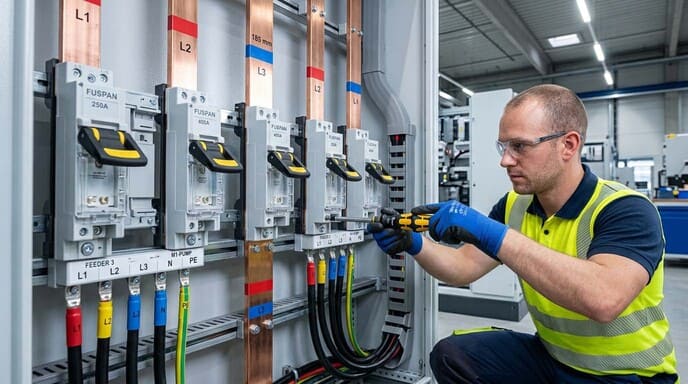
A wrong fuse rail can make a panel hard to wire, hard to maintain, and unsafe under load. I have seen this problem in real cabinets.
I usually divide fuse rails into DIN rail mounted fuse rails, busbar fuse rails, NH fuse rails, modular fuse rails, and single-pole or multi-pole fuse rails. The right type depends on current rating, fuse size, voltage, wiring layout, cabinet space, and required safety standards.
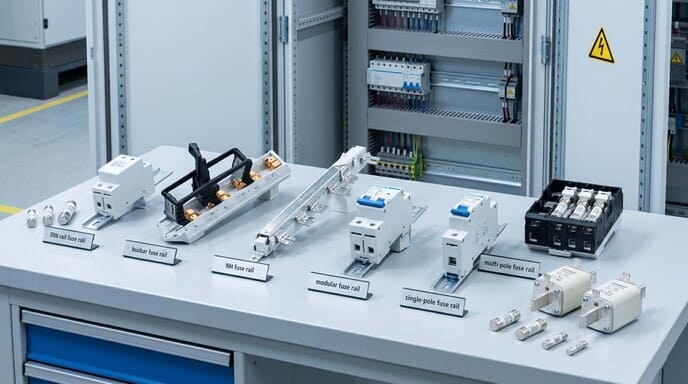
I like to think of a fuse rail as more than a small accessory. I see it as a current path, a mounting structure, and a service point inside the panel. If I choose it well, the cabinet becomes easier to build and easier to repair. If I choose it poorly, every later step becomes harder.
What is the difference between a fuse rail and a fuse holder?
A fuse holder can look simple, so it is easy to choose the wrong part. I have seen buyers treat fuse rails and fuse holders as the same thing.
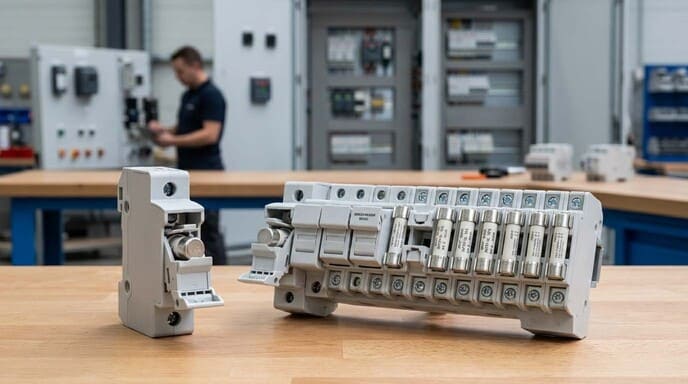
A fuse holder mainly holds one fuse and connects it to the circuit. A fuse rail is a wider mounting and connection solution. I usually use fuse rails in control cabinets, power distribution panels, and systems that need neat wiring, repeat installation, and easy service.
How I separate the two in real projects
When I review a panel drawing, I first ask one simple question. Do I need only to install one fuse, or do I need a structured connection point for several circuits? If I only need one protected branch, a fuse holder may be enough. If I need a clean row of protected outgoing circuits, I prefer a fuse rail. This is common in industrial control panels, PV combiner systems, AC distribution boxes, and OEM cabinets.
| Item | Fuse Holder | Fuse Rail |
|---|---|---|
| Main job | Holds one fuse | Holds and connects one or more fuse circuits |
| Common use | Simple branch protection | Panel wiring and distribution |
| Installation | Panel mount or DIN rail | DIN rail, busbar, or cabinet structure |
| Service | Replace one fuse | Replace fuse and manage circuit layout |
| Best for | Small circuits | Repeated, modular, or high-density wiring |
I also check how the wire enters and leaves the device. A fuse holder may have simple terminals. A fuse rail often gives me better order in the cabinet. It may support several poles, a busbar connection, or a modular layout. This is important when I need stable mass production. At Fuspan, I often meet panel builders who want less wiring time and fewer mistakes. A good fuse rail helps them reach that goal.
How to choose the right fuse rail for a DIN rail?
A DIN rail makes installation simple, but the wrong fuse rail still creates trouble. I have seen panels fail because the current was right, but the size was wrong.
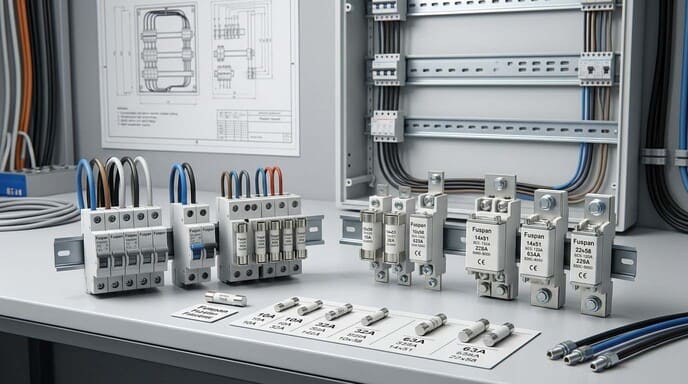
I choose a DIN rail fuse rail by checking fuse size, rated current, rated voltage, pole number, cable size, cabinet space, terminal style, heat rise, and certifications. I also confirm that it fits the actual DIN rail and the panel layout.
My basic checklist before I confirm a DIN rail fuse rail
I do not start with price. I start with the electrical data and the installation data. For small control circuits, I often see 10×38 mm fuse rails. For larger loads, I may check 14×51 mm or 22×58 mm types. If the project uses NH fuses, I check another product family, because NH parts need stronger structures and larger current paths.
| Check point | What I confirm | Why I care |
|---|---|---|
| Fuse size | 10×38, 14×51, 22×58, or NH | The fuse must fit safely |
| Rated current | 32A, 50A, 100A, or higher | The rail must not overheat |
| Rated voltage | AC or DC voltage level | Arc safety is different |
| Number of poles | 1P, 2P, 3P, or 4P | The layout must match the circuit |
| Cable size | Input and output wire range | Wiring must be tight and safe |
| Certification | IEC, GB, or project standard | Export projects need proof |
I also look at the cabinet depth. Some DIN rail fuse rails look good in a catalog, but they leave too little room for bending wires. This creates stress at the terminal. I also check if the terminal screw is easy to reach with a normal tool. In my work, installation time matters because panel builders repeat the same job many times. A fuse rail that saves two minutes per unit can save many hours in one batch.
What is the current rating of standard fuse rails?
Current rating is often the first number people ask about. It is important, but it can mislead me if I do not check the whole system.
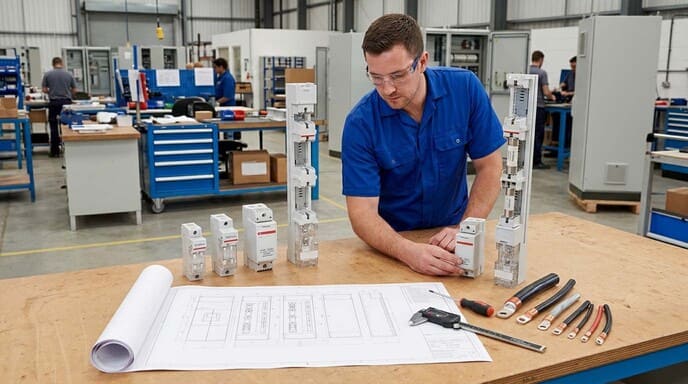
Standard fuse rails may range from about 32A for 10×38 mm fuse types to 50A for 14×51 mm and 100A for 22×58 mm. NH fuse rails can reach 160A, 250A, 400A, 630A, or higher, based on size and design.
How I read current rating without making a mistake
I treat current rating as a limit under defined test conditions. I do not treat it as a promise for every cabinet. Real current performance depends on ambient temperature, wire size, terminal pressure, ventilation, fuse type, and load pattern. A 100A fuse rail may work well in one cabinet and run too hot in another cabinet if the wiring is crowded and the air flow is poor.
| Fuse rail type | Common fuse size | Typical current range | Common place I use it |
|---|---|---|---|
| Small DIN rail type | 10×38 mm | Up to about 32A | Control circuits, small branches |
| Medium DIN rail type | 14×51 mm | Up to about 50A | Machines, sub-circuits |
| Large DIN rail type | 22×58 mm | Up to about 100A | Higher load branches |
| NH fuse rail | NH00, NH1, NH2, NH3 | 160A to 630A or higher | Main distribution and feeders |
| Busbar fuse rail | Depends on system | Based on busbar design | Compact distribution boards |
I also check the derating rule when the cabinet has high temperature. In many factories, the panel may be close to motors, drives, or outdoor heat. This makes the rail hotter. I prefer to leave a safety margin. I also ask for temperature rise test data when the project is serious. In export work, I do not rely only on a printed current number. I ask the manufacturer for a datasheet, test standard, and material details.
What material is best for fuse rails: Brass or Copper?
Material choice sounds simple, but it affects heat, voltage drop, strength, and cost. I have seen both copper and brass work well in the right place.
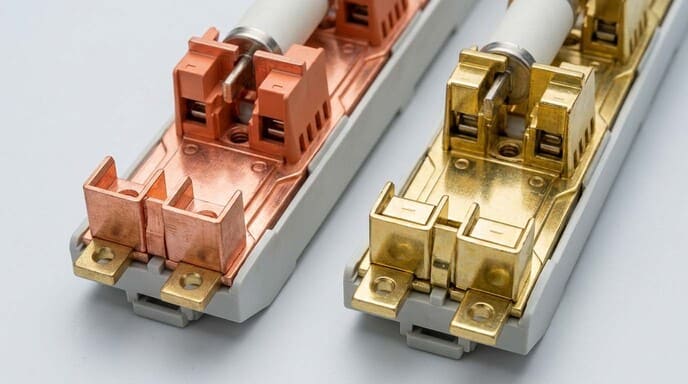
Copper has better conductivity and lower resistance, so I prefer it for high-current fuse rails. Brass has good mechanical strength and a better cost position. For many normal applications, brass with good plating can be acceptable when the design and testing are correct.
How I compare brass and copper in a fuse rail
I do not say one material is always best. I choose based on current, temperature rise, mechanical force, and project budget. Copper is usually better when the current is high. It carries current with less loss. This means lower heat under the same load. Copper is also common in busbar and NH fuse systems because the current path must be strong and stable.
| Material | Strong point | Weak point | My common use |
|---|---|---|---|
| Copper | High conductivity and low resistance | Higher cost and softer than brass | High-current rails and busbar paths |
| Brass | Good strength and stable screw holding | Higher resistance than copper | Normal fuse holders and medium loads |
| Plated brass | Better surface protection | Quality depends on plating | Cost-sensitive standard products |
| Plated copper | Good current path and surface protection | Higher cost | Export-ready high-load components |
I also care about plating. A good plated surface can reduce oxidation and improve contact stability. Tin plating is common in many low-voltage parts. Nickel plating may be used in some conditions. The base material is important, but the stamping quality, contact pressure, terminal design, and assembly control are also important. At Fuspan, I see material selection as one part of the total design. A thick copper part with poor contact design can still perform badly. A well-designed plated brass part can perform well in normal loads.
What is the insulation resistance of a fuse rail?
Insulation resistance is easy to ignore because it is not visible. I still check it because poor insulation can create leakage, failure, and safety risk.
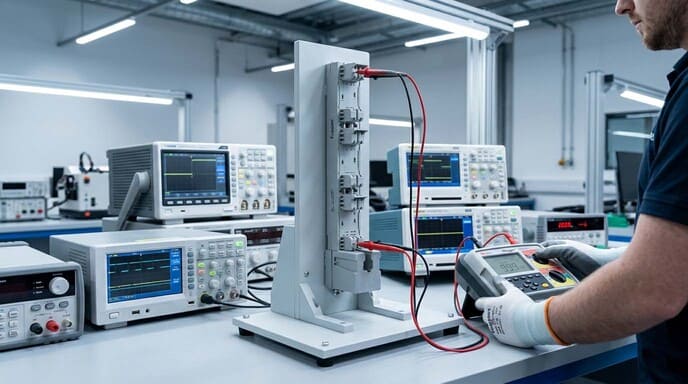
A qualified fuse rail usually has insulation resistance of at least 100 MΩ. Better products may reach 500 MΩ or more. I always confirm the final value from the manufacturer’s datasheet and the test condition, such as test voltage and humidity.
How I judge insulation resistance in practice
I never read insulation resistance as a single number without context. I ask how it was tested. The test voltage matters. The test time matters. Temperature and humidity also matter. A fuse rail used in a dry indoor cabinet is not the same as one used in an outdoor distribution box. Moisture, dust, and creepage distance can change the real safety level.
| Item I check | Typical point | Why I check it |
|---|---|---|
| Insulation resistance value | 100 MΩ or higher | Basic safety level |
| Better product level | 500 MΩ or higher | More margin for demanding use |
| Test voltage | Often defined by standard | Different voltage gives different results |
| Insulation material | PA, PC, DMC, or other material | Heat and tracking resistance matter |
| Creepage and clearance | Based on voltage and pollution degree | Prevents flashover and leakage |
| Datasheet proof | Manufacturer test data | Needed for export and approval |
I also look at the plastic material around live metal parts. The material should resist heat and flame. It should keep shape after long use. A fuse rail may pass a basic insulation test when new, but poor material can age fast under heat. I prefer suppliers who can provide stable material records and batch traceability. In export projects, this reduces risk. I also like to see 100% testing before shipment, because small insulation problems can become large field problems later.
Conclusion
I choose fuse rails by type, rating, material, insulation, and layout. A good choice makes the panel safer, cleaner, and easier to maintain.