I have seen many people choose the wrong fuse rail first. That mistake costs time, space, and sometimes safety.
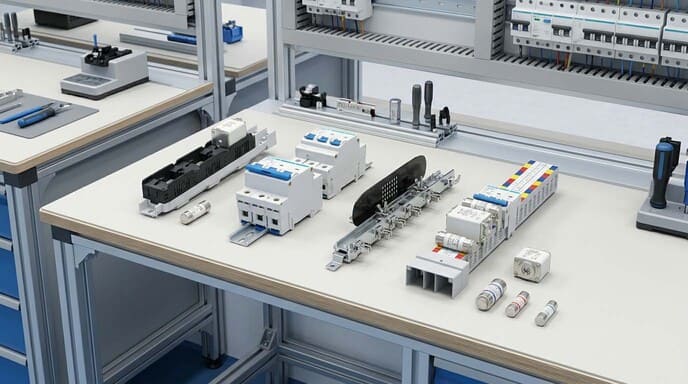
A fuse rail is a mounting and connection solution for one or more fuses, and the right type depends on the fuse size, current, voltage, pole count, and installation method. In my work, I usually group fuse rails into DIN rail mounted fuse rails, busbar fuse rails, NH fuse rails, modular fuse rails, and single-pole or multi-pole fuse rails.
The real problem is not only the fuse itself. The real problem is how well the fuse rail fits the cabinet, the load, and the service need.
What Types Exist?
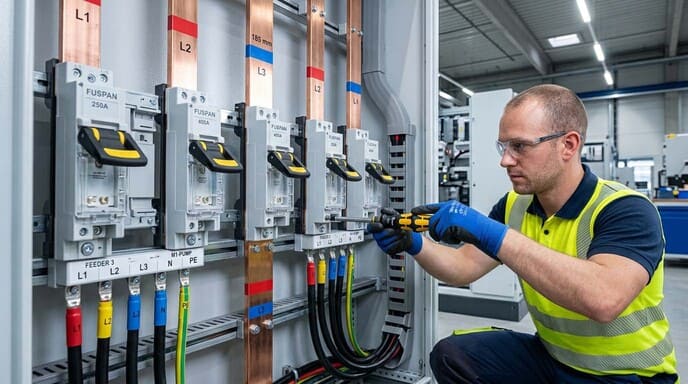
I usually divide fuse rails into a few clear types. DIN rail mounted fuse rails are the most common in control panels because they are easy to install and easy to replace. Busbar fuse rails are used when the system needs a stronger and more direct power path. NH fuse rails are used for higher current levels in power distribution1. Modular fuse rails are flexible and suit systems that need different pole arrangements. Single-pole and multi-pole fuse rails are chosen based on how many circuits need protection at the same time.
The most important point is that each type serves a different layout and current demand. A small control cabinet does not need the same structure as a large distribution system. In my experience, the more compact the cabinet, the more valuable a DIN rail design becomes. It saves space, and it also keeps the installation neat. When I work on export projects, I always check whether the rail type matches the fuse family and the mounting standard first.
Fuse Rail vs Fuse Holder
A fuse holder mainly holds one fuse and connects it into the circuit2. A fuse rail is usually a more complete mounting and connection solution, and it can support one fuse or several fuses in a structured way. This is why many people use a fuse holder for simple local protection, but they use a fuse rail in control cabinets and distribution systems.
I think the difference becomes clear when you look at the job each one does. A fuse holder is like a single seat. A fuse rail is more like a small platform that can hold one seat or several seats in order. In practice, I often choose a fuse rail when I need better wiring order, faster replacement, and cleaner cabinet layout. This also makes maintenance easier for electricians.
Choosing DIN Rail Types
When I choose a fuse rail for a DIN rail, I do not look at current rating alone. I also check fuse size, rated voltage, number of poles, cable size, installation space, and certifications. Common fuse sizes include 10×38 mm, 14×51 mm, and 22×58 mm. These sizes often match typical industrial needs, but the cabinet design still decides the final choice.
The DIN rail itself also matters. A standard TS35 rail is very common in control systems3, and it is used for many electrical parts. I usually confirm the rail depth, the width of the fuse rail body, and the wiring direction before I place an order. If the panel is tight, a compact body can save a lot of trouble during installation. If the project is for export, I also check IEC and GB compliance early, because a mismatch can stop the whole project later.
Current Ratings
The current rating of a standard fuse rail depends on the fuse size and the structure of the rail. In many common cases, 10×38 mm fuse rails are around 32A, 14×51 mm fuse rails are around 50A, and 22×58 mm fuse rails are around 100A. NH fuse rails can go much higher, such as 160A, 250A, 400A, 630A, or even above that.
I always treat current rating as a system decision, not a single number. The rail must handle the thermal load, the conductor size, the contact design, and the cabinet ventilation. A 100A rating on paper does not help if the terminal area becomes too hot in real use. That is why I ask for datasheet values and test data before I confirm the final design. In my experience, a stable product is one that keeps its rating under real working conditions, not only in a brochure.
Brass Or Copper?
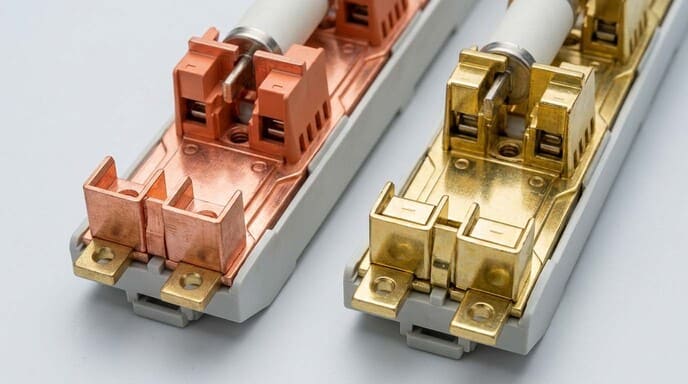
For material selection, copper has better conductivity and lower resistance4. That makes it better for high-current use and for places where heat rise must stay low. Brass has good mechanical strength, and it is often more cost-effective. In many normal applications, brass with good plating is acceptable.
I usually make this choice based on the working current and the project budget. If the application is heavy duty, I lean toward copper. If the system is more general and cost control matters, brass is often a practical choice. Surface plating also matters because it affects oxidation and contact stability. So I never judge the material by name alone. I check the full structure, the plating, and the real test values before I decide.
Insulation Resistance
For insulation resistance, qualified fuse rails are usually at least 100 MΩ, and better products may reach 500 MΩ or more. This value matters because it shows how well the product resists leakage between live parts and the surrounding structure. A higher value usually gives me more confidence in long-term safety and stable use.
I always ask for the final manufacturer datasheet instead of guessing from appearance. Two products can look almost the same and still perform very differently. In a real cabinet, humidity, dust, and long service life can all affect insulation performance. So I treat insulation resistance as one of the key checks, not as a small extra item. For export work, I also like to confirm test methods, because the number means little if the test condition is unclear.
My Selection Method
When I choose a fuse rail, I start with the application. I ask whether the system is for control, distribution, new energy, or industrial use. Then I check the fuse type, the current, the voltage, and the installation space. After that, I confirm the mounting style, the material, and the certification need.
This method saves time. It also avoids many small problems during installation. For example, a rail that fits the fuse size may still fail if the cable space is too small. A rail with good current capacity may still be a bad choice if the panel builder cannot mount it cleanly. In my experience, the best fuse rail is the one that fits the system in a simple and safe way. That is why I always compare technical data with the real cabinet layout before I make the final choice.
Conclusion
I see fuse rails as a practical part of a larger protection system, not as a simple accessory. The right choice depends on structure, current, material, insulation, and the real job the panel must do.
-
"Product - Fuspan High-Quality Low Voltage Electrical Components", https://fuspan.com/product/. References on NH fuse systems describe them as low-voltage, high-breaking-capacity fuse links used in distribution boards and industrial power distribution, with standardized sizes covering high current ratings. Evidence role: general_support; source type: institution. Supports: NH fuse rails are used for higher current levels in power distribution.. Scope note: The source can support typical NH fuse applications and current ranges, but exact current capacity depends on the NH size, standard, and product design. ↩
-
"Thermal-electrical modeling of an automotive fuse - User Assistance",Electrical references define a fuse holder as a device that receives a fuse and provides the electrical terminals needed to connect the fuse into a circuit. Evidence role: definition; source type: encyclopedia. Supports: A fuse holder holds a fuse and connects it into the circuit.. Scope note: Some fuse holders are modular or multi-pole, so the source supports the basic function rather than a strict rule that every holder contains only one fuse. ↩
-
"DIN rail.IEC 60715 and DIN rail references identify the 35 mm top-hat rail, often called TS35, as a standardized rail profile widely used for mounting control and switchgear components. Evidence role: historical_context; source type: institution. Supports: A standard TS35 rail is common in control systems.. Scope note: The source supports the standardized and widespread use of TS35 rails, but may not provide a numerical measure of how common they are in all control systems. ↩
-
"Resistivity of Common Conductors",Materials-property references list copper as having substantially higher electrical conductivity and lower resistivity than common brasses, supporting its frequent use in high-conductivity electrical conductors. Evidence role: mechanism; source type: education. Supports: Copper has better electrical conductivity and lower resistance than brass.. Scope note: Conductivity alone does not determine the performance of a fuse rail; geometry, plating, contact pressure, and temperature also affect resistance and heat rise. ↩