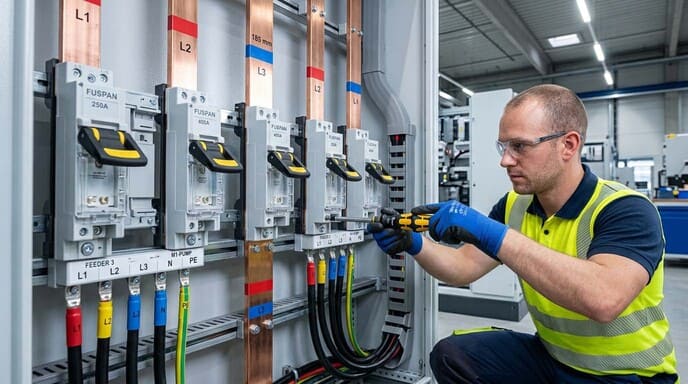
I have seen many panel builders lose hours because every breaker, copper part, and wire path must be adjusted by hand.
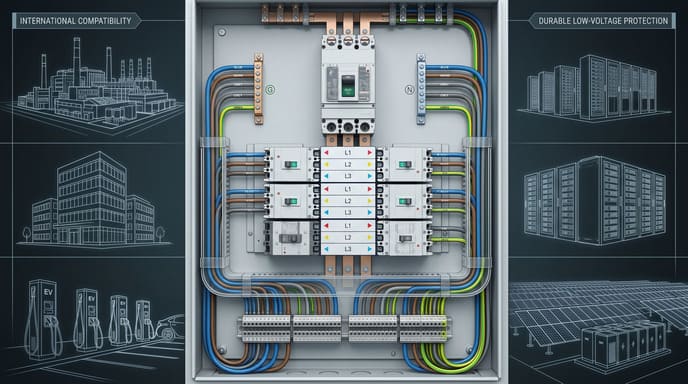
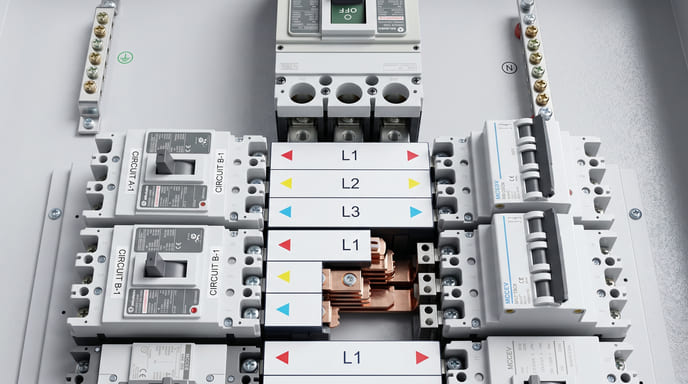
Hybrid pan assemblies reduce installation time by combining MCCB and MCB mounting, copper connection, and layout planning into one prepared structure.1 I use them to reduce separate fixing work, shorten wiring time, lower rework risk, and help panel builders finish distribution boards faster.
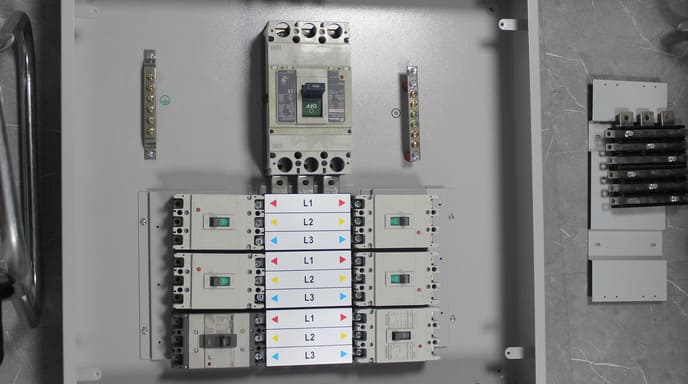
In my daily work at Fuspan, I often hear the same pressure from panel builders. They need to deliver faster, but they cannot always add more skilled workers. They also face changing breaker brands, different outgoing circuits, and short project deadlines. A hybrid pan assembly helps because it moves much of the hard planning work from the workshop floor into the assembly design stage. This means the panel team can spend less time deciding, measuring, drilling, cutting, and correcting.2 They can spend more time on final fitting, wiring checks, and delivery.
Can Hybrid Pan Assemblies Lower Labor Costs for Panel Builders?
Labor cost becomes a real problem when skilled workers spend too much time on repeated mounting, copper preparation, and layout adjustment.
Hybrid pan assemblies can lower labor costs because they reduce manual installation steps.3 I use a prepared modular base so workers can install MCCBs, MCBs, and copper parts faster, with fewer measurements and fewer repeated adjustments.
Why Labor Time Is Often Hidden in Panel Production
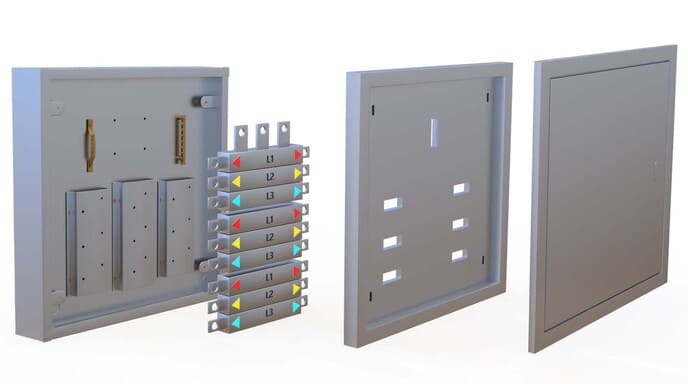
When I look at a distribution board workshop, I do not only count the time used for final assembly. I also look at the hidden time. Workers spend time checking drawings. They measure breaker spacing. They prepare copper bars. They drill mounting holes. They adjust terminal positions. They correct small mistakes. These actions may look small, but they add up fast across many panels.
A hybrid pan assembly reduces this hidden labor because the main structure is already planned. The breaker positions, copper routes, and phase layout are fixed in a clean way. The worker does not need to create the layout from zero each time. This is especially useful when labor availability is tight. A panel builder may have many orders, but only a few skilled technicians. In this case, the assembly must help workers do the job faster and with less pressure.
| Labor Step | Traditional Method | Hybrid Pan Assembly Method | My Practical View |
|---|---|---|---|
| Breaker positioning | Measured and adjusted by hand | Fixed by prepared structure | I reduce repeated work |
| Copper fitting | Cut and drilled more often | Designed as matched parts | I save skilled labor time |
| Wiring route | Decided during assembly | Planned in advance | I reduce confusion |
| Rework | More likely after mismatch | Lower with standard layout | I reduce repair time |
| Training | Needs more experience | Easier for new workers | I support faster team output |
How MOD Customization Helps Labor Control
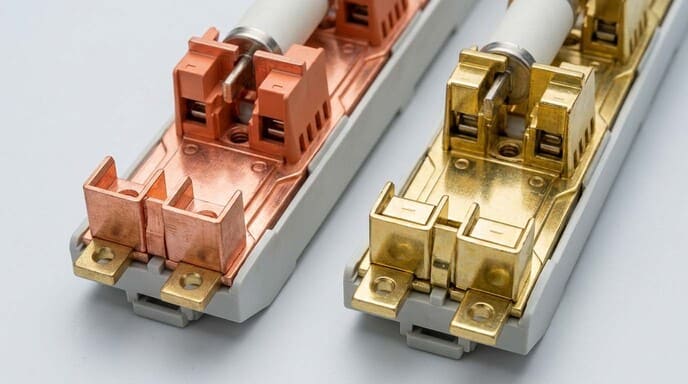
At Fuspan, we offer MOD, which means Modular Design customization services. I see MOD as a practical way to support different circuit breaker brands and different project layouts. It is mainly used for copper components inside hybrid switchboard assemblies. It allows the customer to choose materials based on actual requirements. This gives the panel builder a safer and more reliable structure without asking workers to solve every detail on site.
For example, if a customer uses one breaker brand for MCCBs and another brand for MCBs, the copper parts and mounting structure must match the real dimensions. If this is not planned early, the workshop team will spend extra time modifying parts. MOD customization reduces this problem.4 I can help prepare the assembly so it fits the required breaker and feeder layout. This lowers labor cost because the panel builder does not need to depend too much on manual correction during production.
How Do Hybrid Pan Assemblies Reduce Material Costs?
Material waste can quietly reduce profit when copper, insulation parts, terminals, and mounting hardware are prepared separately for every board.
Hybrid pan assemblies reduce material costs by using a planned copper structure, shared mounting base, and optimized breaker layout. I can select copper components based on real load needs, reduce oversizing, and avoid unnecessary material cutting and waste.
Why Material Cost Is More Than the Price of Copper
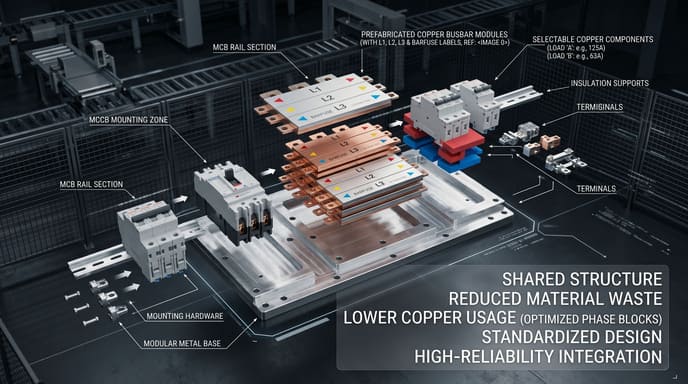
Many people first think about copper price when they talk about material cost. I agree that copper is important, but I also look at other cost areas. Material cost includes offcuts, extra screws, support pieces, insulation boards, rejected parts, and spare parts kept for correction. A traditional build often creates waste because each board may need separate copper preparation. If the layout changes, the copper may need to be remade.
A hybrid pan assembly reduces this waste by using a planned structure. The copper parts are designed to match the MCCB and MCB positions. The material can be selected based on current level, customer standard, and project demand. I do not need to use one heavy structure for every small outgoing circuit. I can use the right size of copper and the correct breaker type in the correct position.
| Material Area | Traditional Risk | Hybrid Assembly Advantage | Result I See |
|---|---|---|---|
| Copper bars | More cutting and offcuts | Planned copper routes | Less material waste |
| Breaker choice | MCCB used too often | MCCB and MCB mixed | Lower device cost |
| Mounting parts | Many separate supports | Shared assembly base | Fewer loose parts |
| Insulation parts | Custom cut more often | Designed with structure | Better material use |
| Spare parts | Kept for correction | Lower rework need | Less stock pressure |
Why Right-Sized Protection Saves Money
In many projects, I see outgoing feeders with very different loads. Some loads need MCCBs. Some smaller loads only need MCBs. If the pan assembly only supports MCCBs, the panel builder may be forced to use MCCBs for circuits that do not need them. This increases the cost of breakers and also increases the size and copper demand of the board.
A hybrid pan assembly avoids this problem. I can match the protection device to the real load. I can use MCCBs for larger feeders and MCBs for smaller circuits. This saves material because the whole internal structure does not need to be built around oversized outgoing devices. It also makes stock planning easier. The customer can choose material requirements for copper components through MOD customization. This helps balance cost, safety, and performance. I see this as a change from simple component buying to better system planning.
Do Hybrid Pan Assemblies Improve Assembly Efficiency?
A panel team can work hard all day, but efficiency stays low if every board needs new decisions during installation.
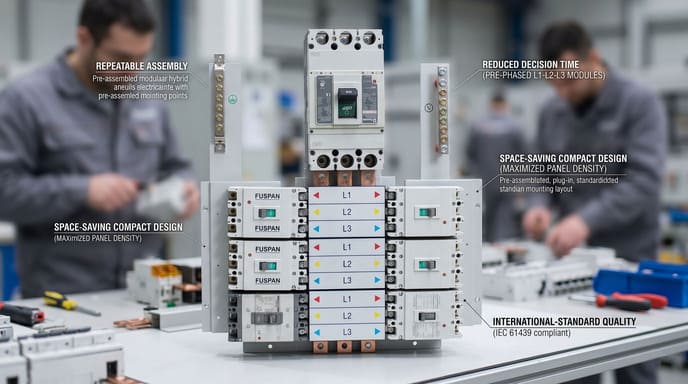
Hybrid pan assemblies improve assembly efficiency because the layout, mounting points, and copper connections are prepared as one system. I use them to simplify workflow, reduce decision time, and make panel production more repeatable.
Why Repeatable Work Is Faster Work
In panel building, speed does not only come from working faster. It also comes from working in the same clear way every time. When each distribution board has a different internal layout, the team must slow down and check every step. They must confirm breaker spacing, busbar position, wiring route, and fixing method. This creates delay. It also creates more chances for mistakes.
Hybrid pan assemblies make the work more repeatable. The incoming and outgoing areas are arranged in a planned pattern. MCCBs and MCBs can share one organized structure. The copper parts are not random pieces. They are part of the full assembly design. This helps the worker understand the board faster. It also helps quality inspectors check the board faster because the structure is cleaner and more consistent.
| Efficiency Factor | Without Hybrid Assembly | With Hybrid Assembly | My Observation |
|---|---|---|---|
| Layout decision | Made during production | Set before production | Faster start |
| Worker skill demand | Very high for every step | More balanced | Easier team planning |
| Assembly sequence | Can change often | More standard | Smoother workflow |
| Inspection | Takes longer | More visual and clear | Faster checking |
| Rework risk | Higher | Lower | Better delivery control |
How Efficiency Helps Compressed Delivery Windows
I often see panel builders face compressed delivery windows. The customer wants the board soon. The project site is waiting. The contractor may already have installation workers scheduled. In this situation, one small delay in the workshop can affect the whole project. Hybrid pan assemblies help because they reduce the number of things that must be solved during production.
For example, when the mounting structure is ready, the worker does not need to drill many separate positions. When the copper connection is planned, the worker does not need to make many adjustments. When the MCCB and MCB layout is clear, the wiring team can follow a more direct route. This saves time in assembly and also saves time in checking.
I believe this is why more panel builders are thinking about assembly efficiency instead of only component price. A cheaper loose part may not save money if it creates extra labor, delay, or rework. A prepared hybrid assembly may look like one product, but it can reduce many small tasks across the full panel-building process.
How Can Panel Builders Save Space and Cost with Hybrid Pan Assemblies?
A distribution board becomes larger and more expensive when the internal layout does not match the actual load structure.
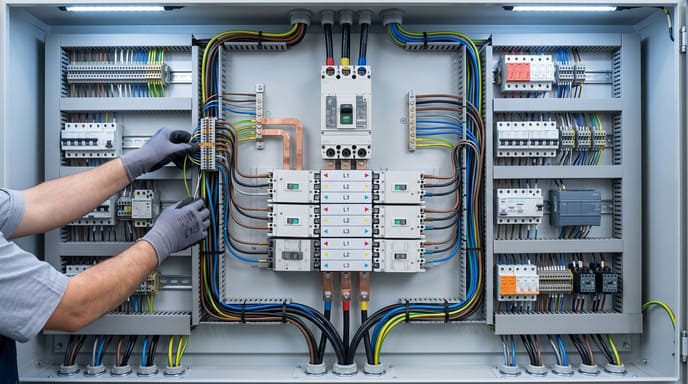
Panel builders can save space and cost with hybrid pan assemblies by using MCCBs only where needed and MCBs where suitable. I use the modular layout to reduce oversized parts, shorten wiring paths, and create a more compact distribution board.
Why Space Saving Starts with Device Selection
Space saving is not only about making a smaller enclosure. It starts with choosing the right protection device for each circuit. MCCBs need more space because they are designed for higher current and stronger breaking capacity.5 MCBs are smaller and are often enough for lower-current branch circuits. If every outgoing feeder must use an MCCB, the board becomes larger than needed.
A hybrid pan assembly gives me more control. I can place MCCBs in the positions that need higher protection. I can place MCBs in the positions that support smaller loads. This makes the internal layout more compact. It also improves wire routing because smaller circuits can be grouped more neatly. In many cases, this helps reduce panel depth, width, or the amount of internal dead space.
| Saving Area | Cause of Waste | Hybrid Solution | Benefit |
|---|---|---|---|
| Panel space | Too many large breakers | Use MCBs for small loads | More compact board |
| Copper cost | Oversized outgoing structure | Match copper to load | Lower material use |
| Labor time | More fixing and wiring | Modular prepared layout | Faster production |
| Rework | Layout mismatch | Designed breaker positions | Fewer corrections |
| Delivery | Slow customization | MOD support | Faster adaptation |
How I Link Space, Cost, and Reliability
I do not see space and cost as separate topics. A smaller and cleaner layout can also improve reliability. When the internal structure is organized, wiring routes are easier to follow. The technician can see each feeder more clearly. Maintenance becomes easier. The board also looks more professional during inspection and handover.
At Fuspan, our MOD customization supports this goal. It can be applied to any circuit breaker requirement when the dimensions and project needs are clear. It is especially useful for copper components inside hybrid switchboard assemblies. The customer can select materials based on safety, cost, current level, and project standard. This makes the solution more flexible without making the production process messy.
I have seen that panel builders gain the most from hybrid pan assemblies when they face both labor pressure and cost pressure. They need to finish boards quickly. They need to avoid waste. They need to keep the structure safe. A hybrid pan assembly supports these needs at the same time. It reduces separate mounting work. It lowers unnecessary copper and breaker cost. It also reduces layout changes that often cause rework. This is why I see it as a practical shift from buying many separate components to thinking about full assembly efficiency.
Conclusion
I use hybrid pan assemblies to reduce installation time, control labor, reduce waste, save space, and help panel builders deliver safer boards faster.
-
"Prefabrication on the Rise: Why Electricians Need Prefab Know-How", https://www.tcneca.org/prefabrication-on-the-rise-why-electricians-need-prefab-know-how/. A source on prefabrication or modular electrical assemblies can support the general proposition that integrating mounting, connection, and layout tasks before site or shop installation reduces installation activity and coordination time; this would be contextual support rather than direct proof for this specific hybrid pan assembly design. Evidence role: general_support; source type: paper. Supports: Hybrid pan assemblies reduce installation time by integrating breaker mounting, copper connection, and layout planning into a prepared structure.. Scope note: Support is likely to be general to prefabrication or modular electrical work, not a direct time study of the article’s specific product. ↩
-
"[PDF] Module 3D: Design for Manufacturing and Assembly", https://www.energy.gov/sites/default/files/2021-07/Module_3D.pdf. Research on prefabrication and design-for-assembly can substantiate that transferring repetitive measuring, drilling, cutting, and adjustment tasks into pre-engineered components can reduce on-site or workshop labor steps; the evidence may not quantify savings for distribution-board pan assemblies specifically. Evidence role: mechanism; source type: research. Supports: Moving planning and repetitive fabrication into the assembly design stage reduces manual workshop tasks such as measuring, drilling, cutting, and correction.. Scope note: The source may describe the mechanism broadly across prefabrication rather than this exact assembly type. ↩
-
"State of Prefab Practice in the Electrical Construction Industry", https://ascelibrary.org/doi/10.1061/%28ASCE%29CO.1943-7862.0001236. A labor-productivity source on electrical prefabrication can support the inference that reducing manual installation steps lowers labor hours and therefore labor cost; the support should be treated as conditional because labor-cost savings depend on local wage rates, production volume, and process control. Evidence role: mechanism; source type: paper. Supports: Hybrid pan assemblies can lower labor costs by reducing manual installation steps.. Scope note: Labor-cost reduction is an inferred outcome from reduced labor hours and may vary by workshop conditions. ↩
-
"The size and design of the busbar system shall be ... - Facebook", https://www.facebook.com/groups/604728486272187/posts/1666126180132407/. Standards or technical references on switchgear assemblies and manufacturer-specific device dimensions can support the need to match busbars, mounting structures, and protective devices to actual equipment dimensions; this supports the rationale for customization rather than independently verifying the named MOD service. Evidence role: mechanism; source type: institution. Supports: Customizing copper parts and mounting structures to actual breaker dimensions reduces fit-up modification problems during production.. Scope note: The source should not be used as evidence that the proprietary MOD service itself performs as claimed. ↩
-
"MCBs vs MCCBs: When Can I use a MCB in place of an MCCB?", https://www.c3controls.com/blog/mcbs-vs-mccbs?srsltid=AfmBOoo8D4gM-p2_-11VP4pEojT0t4RpwQAjUBGQlBbghCWK9XzfrE6h. A technical reference on low-voltage protective devices can support that MCCBs generally cover higher current ratings and interrupting capacities than MCBs, which commonly results in larger device dimensions; device size varies by manufacturer, pole count, and rating. Evidence role: definition; source type: education. Supports: MCCBs generally require more space than MCBs because they are designed for higher current and breaking-capacity applications.. Scope note: The size relationship is general and should not be applied without checking specific device datasheets. ↩