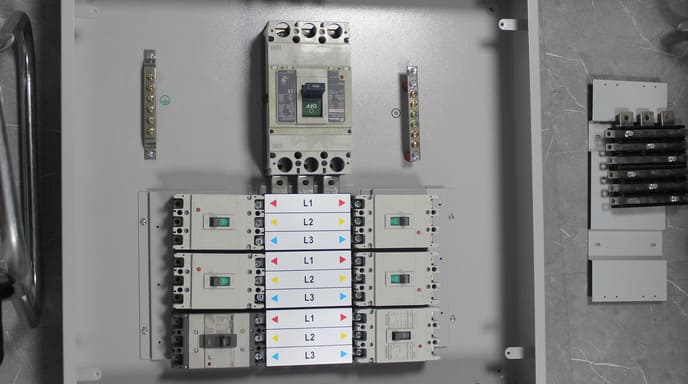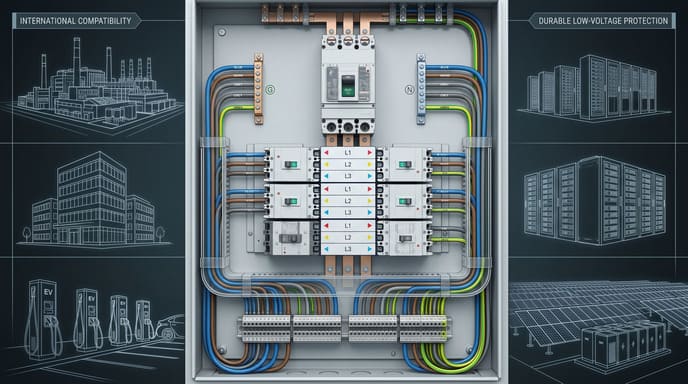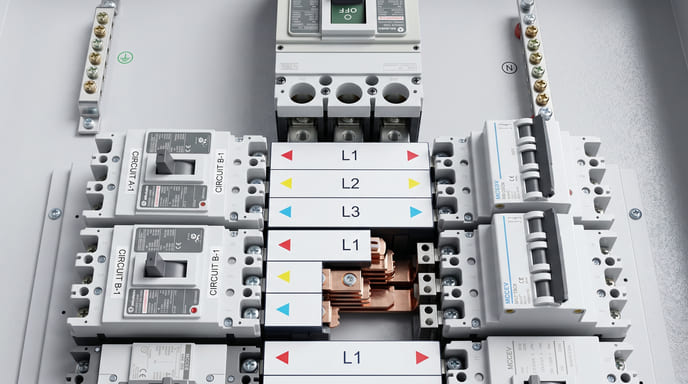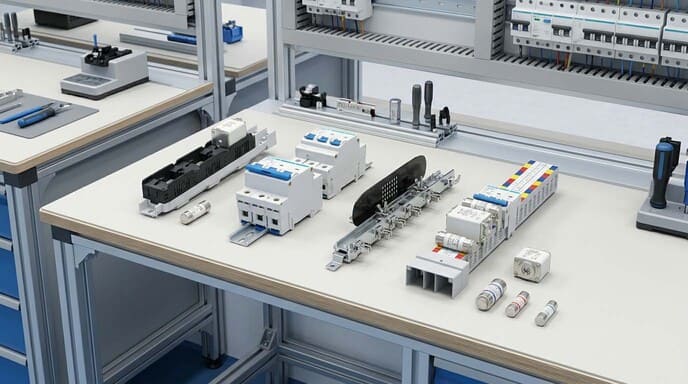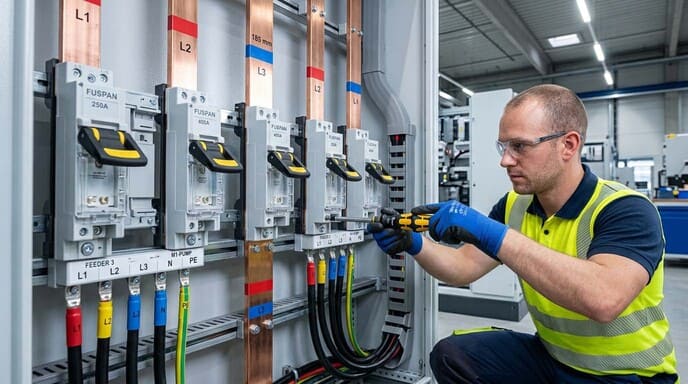
Low-voltage upgrades can become risky fast. I see crowded panels, hot cables, and unclear protection points. A fuse rail solves this in one simple structure.
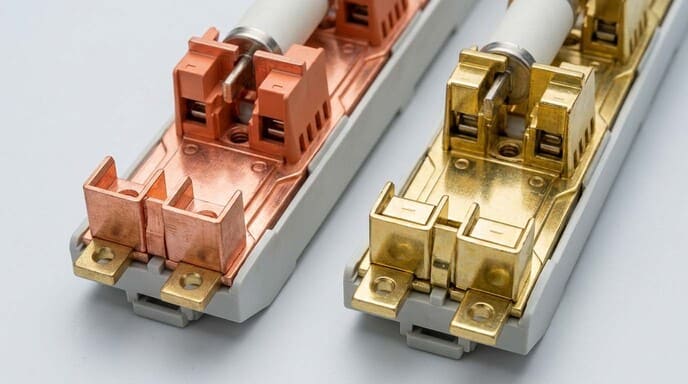
A fuse rail is used to mount NH fuse links on a low-voltage busbar system, protect outgoing circuits, and isolate feeders safely. I use it in distribution panels where I need compact protection, clear cable connection, and easy expansion.
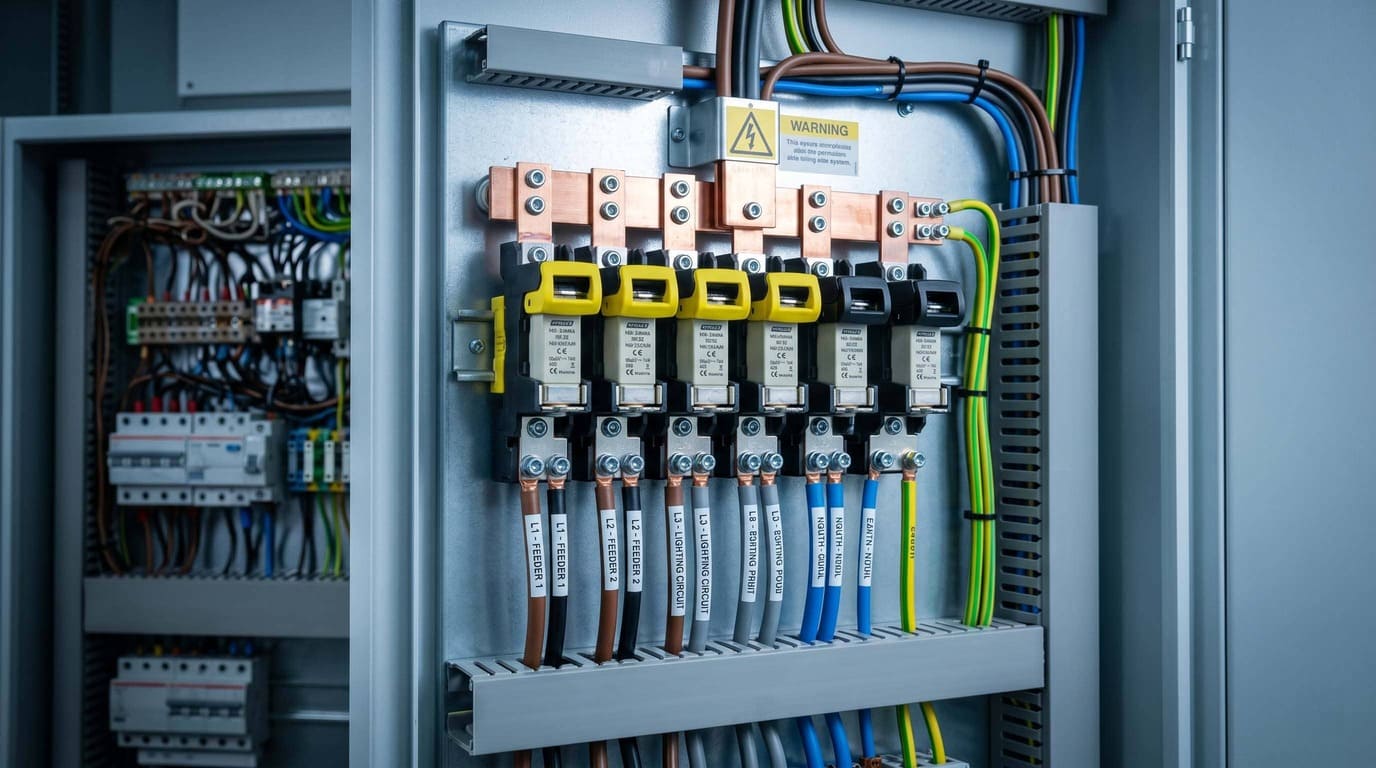
I often describe a fuse rail as a practical bridge between protection and distribution. It is not only a place to install a fuse. It also helps me organize feeders, reduce wiring space, and prepare the panel for future load growth. When I work with panel builders, I always look at standards, rated values, NH fuse size, and busbar mounting first. These points decide if the system will be safe today and easy to upgrade tomorrow.
What standards does fuse rail comply with?
A fuse rail without clear standards can create hidden risk. I have seen buyers focus on price first. That choice can lead to unsafe panels later.
A fuse rail usually follows low-voltage switchgear and fuse protection standards, such as IEC 60947-3 for switching and isolation1, and IEC 60269 for NH fuse links2. I also check GB standards, test reports, and factory quality control records.
I check the standard before I check the price
When I choose a fuse rail, I first confirm the application. A fuse rail works in a low-voltage distribution system. It must isolate safely. It must carry current without overheating. It must hold NH fuse links with stable contact pressure. I do not treat it like a simple plastic and copper part.
| Standard or control point | What I check | Why I care |
|---|---|---|
| IEC 60947-3 | I check switch disconnector function | I need safe isolation under rated conditions |
| IEC 60269 | I check NH fuse link matching | I need correct fuse protection behavior |
| GB standards | I check local compliance records | I need stable quality for export projects |
| ISO 9001 | I check factory process control | I need repeatable production quality |
| 100% inspection | I check test process before shipment | I need fewer site failures |
I treat compliance as a system issue
I do not look at a fuse rail as one isolated product. I look at the full electrical path. The busbar, the fuse link, the cable lug, the cover, and the contact point must work together. A standard-compliant fuse rail helps me reduce failure risk. It also helps my customers pass inspection more smoothly. In my daily work at Fuspan, I often explain that a good product must be easy to prove. Clear drawings, rated labels, material records, and inspection steps all matter. A project can move faster when the technical data is complete.
What rated current and voltage are available for fuse rail?
Wrong ratings create heat, nuisance shutdowns, and early failure. I have seen systems look fine at first, then fail during peak load.
Fuse rails are commonly available in 160A, 250A, 400A, and 630A versions3, depending on NH fuse size and design. Rated voltage is often 400V, 500V, or 690V AC, while DC ratings must be confirmed by model and application.
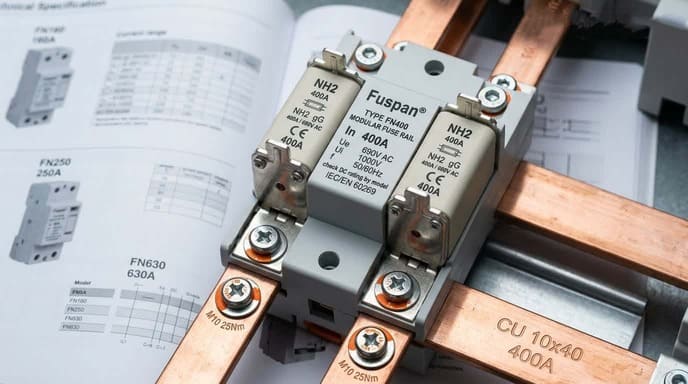
I size the fuse rail by real load current
I always start with the actual load current. I do not choose the exact same value as the load. I usually keep a 20–30% safety margin. This habit helps me handle normal load changes, site temperature changes, and future expansion. For example, if a feeder runs near 120A, I will not treat a 125A solution as safe enough in every case. I will check cable size, enclosure temperature, duty cycle, and spare capacity.
| Common fuse rail class | Common NH size | Typical current range | Common use case |
|---|---|---|---|
| 160A | NH00 | Small feeders | Compact distribution boards |
| 250A | NH1 | Medium feeders | Commercial panels |
| 400A | NH2 | Larger feeders | Industrial distribution |
| 630A | NH3 | High load feeders | Main outgoing circuits |
I never separate current from temperature
Rated current is not only a number on a label. It depends on installation conditions. A hot room changes the result. A closed cabinet changes the result. Poor contact pressure also changes the result. I apply derating when the temperature is high. I also check torque values during installation. Loose connections create heat. Too much torque can damage the conductor or terminal. I prefer fuse rails with solid contact design, clear cable terminals, and stable mechanical structure. I also like models with IP20 touch protection covers and fuse-blown indicators. These features make operation safer and maintenance faster.
I confirm voltage before AC or DC use
I treat AC and DC ratings differently. A product that works for AC may not be suitable for DC. DC breaking and arc behavior need special attention. I confirm the rated voltage from the datasheet and the fuse link data. I also check if the supplier can provide technical support in English, drawings, and project documents. This makes export projects easier and reduces mistakes during approval.
Which NH fuse link sizes are compatible with fuse rail?
A wrong NH size can stop installation at once. I have seen site teams lose time because the fuse rail and fuse link did not match.
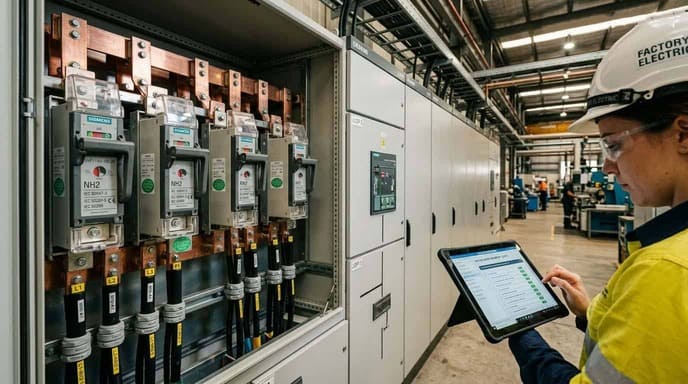
Fuse rails are commonly designed for NH00, NH1, NH2, and NH3 fuse links4. The correct size depends on the rail rating, contact design, mounting space, cable terminal, and required selectivity in the low-voltage system.
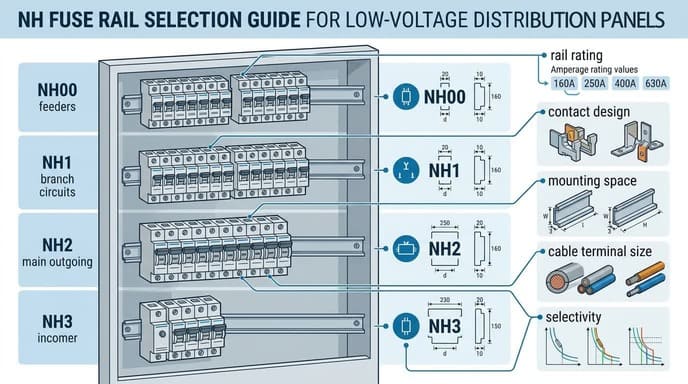
I match the NH fuse size to the feeder role
NH fuse links are common in low-voltage distribution because they are robust and easy to replace. Still, I never choose an NH size only by habit. I match it to the load, the cable, the upstream device, and the downstream circuit. I also check the rail structure. A rail for NH00 cannot be used for NH2. The contact distance, fixing point, and current path are different.
| NH fuse link size | Common fuse rail rating | Typical panel role | My selection focus |
|---|---|---|---|
| NH00 | Up to 160A | Small outgoing feeder | Compact space and safe cover |
| NH1 | Up to 250A | Medium outgoing feeder | Cable terminal and heat rise |
| NH2 | Up to 400A | Industrial feeder | Contact pressure and torque |
| NH3 | Up to 630A | Main or large feeder | Busbar strength and cable section |
I look for selectivity before final approval
I want the correct fuse to clear the fault closest to the problem point. This is why I check selectivity. In many projects, I use the common 1:1.6 selectivity rule as a practical starting point. I still confirm it with fuse curves and brand data. A high-quality NH fuse link from a reputable brand gives me better confidence. A weak fuse link can ruin a good rail design. I tell customers that the rail and fuse link should be treated as one protection set.
I care about handling and maintenance
Fuse compatibility also affects daily maintenance. The fuse link should be easy to insert and remove with proper tools. The cover should protect fingers from live parts. The fuse-blown indicator should help the technician find the failed phase faster. I prefer IP20 touch protection when the panel design allows it. I also ask the customer about spare parts. A common NH size is easier to source in Europe, Southeast Asia, South America, and the Middle East. This matters when a factory needs fast repair after a fault.
Can fuse rail be mounted on a busbar system?
A panel without a clean busbar layout becomes hard to expand. I have seen installers spend extra hours fixing space and alignment problems.
Yes, a fuse rail can be mounted directly on a busbar system when the rail matches the busbar spacing, width, thickness, and phase layout. The most common low-voltage vertical system uses 185 mm busbar spacing.
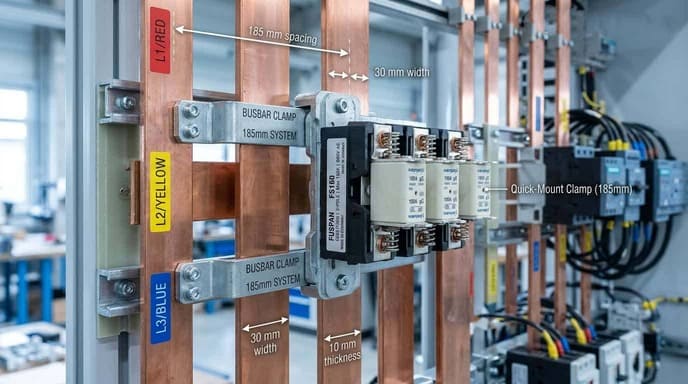
I confirm the busbar system before production
Busbar mounting is one of the main reasons I like fuse rails. It reduces cable clutter. It also makes the panel layout more modular. In many low-voltage cabinets, the 185 mm busbar system is the common choice for vertical fuse rails. I still confirm every detail before I suggest a model. I check the busbar spacing, busbar thickness, phase order, cabinet depth, and outgoing cable direction. A small mismatch can create a large installation problem.
| Busbar detail | What I confirm | Why I confirm it |
|---|---|---|
| Busbar spacing | I often check 185 mm first | I need rail and busbar alignment |
| Busbar thickness | I check clamp compatibility | I need stable electrical contact |
| Busbar width | I check mechanical fit | I need safe mounting pressure |
| Cabinet depth | I check fuse operation space | I need safe maintenance access |
| Cable cross-section | I check terminal range | I need correct cable connection |
I see busbar mounting as a future-ready choice
A busbar-mounted fuse rail helps a distribution system grow. I can add outgoing feeders more cleanly. I can keep the cabinet organized. I can reduce wiring time. This matters for customers who expect load growth in the next few years. It also matters for panel builders who need repeatable cabinet designs. At Fuspan, I often work with customers who need modular systems that match different project layouts. A strong fuse rail helps them keep one design logic across many cabinets.
I follow simple installation rules
I always remind the installation team to use insulated tools. I ask them to follow the correct torque value from the product document. I ask them to check the contact point after installation. I also recommend regular inspection during operation, especially in dusty, humid, or high-temperature environments. A fuse rail is reliable when the whole installation is reliable. The rail, the busbar, the fuse link, and the cable must all be selected and installed as one system.
Conclusion
I use fuse rails to make low-voltage distribution safer, cleaner, and easier to expand. The best result comes from correct standards, ratings, NH size, and busbar matching.
-
"IEC 60947-3:2020",IEC 60947-3 specifies requirements for switches, disconnectors, switch-disconnectors, and fuse-combination units used in low-voltage switchgear and controlgear. Evidence role: definition; source type: institution. Supports: IEC 60947-3 is the relevant standard for switching and isolation functions in low-voltage equipment.. ↩
-
"IEC 60269 - Wikipedia", IEC 60269 is the international standard series for low-voltage fuses and includes requirements used for standardized fuse-link systems such as NH-type low-voltage fuses. Evidence role: definition; source type: institution. Supports: IEC 60269 is the relevant standard series for NH low-voltage fuse links.. Scope note: The exact NH size and utilization category still need to be checked against the relevant part of the standard and the fuse manufacturer’s data. ↩
-
"JSCCMEEQ 1pcs Fuse NH00/NH1/NH2/NH3-100A 160A 250A ...", Technical references for NH fuse systems commonly associate NH00, NH1, NH2, and NH3 equipment with current classes in the approximate ranges of 160 A, 250 A, 400 A, and 630 A. Evidence role: general_support; source type: institution. Supports: Fuse rails are commonly available in 160A, 250A, 400A, and 630A versions.. Scope note: Actual rated current depends on the device design, fuse link, enclosure conditions, and certification of the specific product. ↩
-
"IEC 60269 - Wikipedia", NH low-voltage fuse systems are standardized by physical size designations such as NH00, NH1, NH2, and NH3, which correspond to different current ranges and mounting dimensions. Evidence role: definition; source type: institution. Supports: Fuse rails are commonly designed for NH00, NH1, NH2, and NH3 fuse links.. Scope note: This supports the existence and general use of these NH sizes; compatibility with a specific fuse rail must be verified from the product documentation. ↩